Asceticism
The Glass Bead GameAsceticism is a recurring but varied discipline in the novel: a way of turning from ordinary life in pursuit of spiritual understanding, which may also become a struggle with the self it hopes to transcend. Its forms range from imaginative exercises in Castalia to Christian penitence and the silent yogi’s withdrawal from the world. The episodes resist treating renunciation as effortless or uniform: hardship can unsettle the ascetic, service can nourish vanity, and the longing to escape worldly life can itself become another attachment.
Forms of Renunciation
In the Christian hermit tradition, ascetic life means poverty, withdrawal, and the mortification of the ego: dying to the world in hope of passing through death to the Redeemer. Hermits inhabit the wilderness alone or in small communities, where prayer and devotion answer the brutality and sensuality of worldly life. Their work may include healing, blessing, hymn-writing, or expelling demons. The account also places this tradition beside older Asian practices of purification and spiritual exercises, while noting that such methods have fallen under Christianity’s increasingly strict prohibition of pagan practices. Asceticism thus appears within a contested religious inheritance, not as a universal method untouched by history.
In Castalia, a more playful version survives in the annual “Life” exercise assigned to students not yet admitted to the Order. Each student composes a fictional autobiography set in a chosen period of the past, imagining a suitable existence within its culture and intellectual climate. Knecht writes three such Lives during his years of free study. This is an official educational assignment, unlike the poems he had written secretly at Waldzell. By imaginatively inhabiting another era, students practice regarding their own person as a temporary mask rather than an absolute identity. The exercise retains an echo of reincarnation and the transmigration of souls, but as a flexible imaginative game rather than doctrine; its place in an educational culture that frowns on serious creative work also gives youthful artistic impulses a legitimate outlet.
Christian Penitence and Its Costs
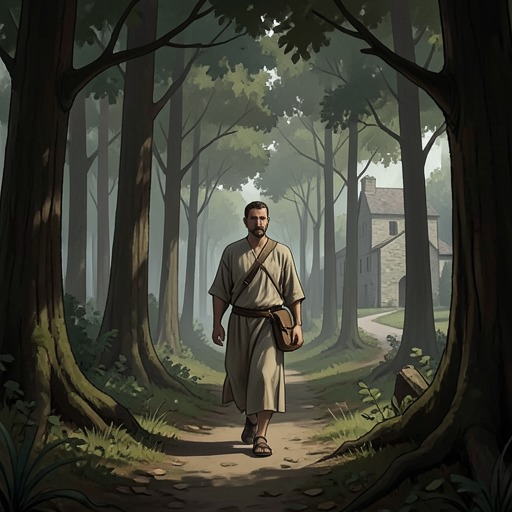
The hermit Josephus Famulus has abandoned his house and possessions and left the city, yet his withdrawal does not immediately free him from temptation. He first wages a harsh struggle against his body, subjecting it to hunger, thirst, and physical austerity. Even as his body grows gaunt, desires, dreams, and hallucinations continue to disturb him. The narrative presents renunciation not as the removal of human impulses but as a prolonged encounter with them.
Josephus’s vocation as a listener gives his solitary life a purpose beyond self-denial. He receives troubled visitors, attends to their accounts of wrongdoing and sorrow, and helps them leave calmer. He experiences their arrival as a sign of grace and as an opportunity to serve God through service to other souls. But spiritual usefulness brings a new danger: he can take pleasure in being needed, recognize vanity in that pleasure, and pray that no more penitents be sent to him. When visitors stop coming, he is no more at ease; when they return, the temptation returns too. He sometimes feels coldness or contempt toward those who confess, and responds with private penances. His effort to treat every visitor with special deference, especially those he likes least, makes humility an active discipline rather than a settled possession.
The peace Josephus eventually seems to attain is similarly unstable. As he approaches old age, it gives way to a gradual waning of joy: days blur together, and the repeated arrivals of travelers and penitents begin to feel burdensome. The spiritual life has not simply advanced from struggle to serenity. Its inward conditions continue to change, and even a reputation for peacefulness cannot prevent spiritual weariness.
Mentorship, Withdrawal, and the Indian Life
In the Indian Life, the ascetic ideal takes another form. Dasa, fleeing after the violence of his former life, reaches the forest hermitage of a silent yogi. He tends the old man, renews his leaf pallet, finds food and water, repairs the hut, and begins building a second shelter nearby. The yogi scarcely seems to notice him. For a time, that quiet and the small daily tasks offer Dasa rest from fear and remorse; he hopes to be accepted as a pupil and to learn the secret of hermit life.
But Dasa cannot sustain the yogi’s stillness. He imitates the ascetic posture and tries to withdraw his attention from the surrounding world, yet discomfort and agitation repeatedly interrupt his practice. Brief moments of lightness and detachment give him a glimpse of what he imagines as life beyond ordinary weight, but the feeling passes, and he returns to his unquiet self. The yogi, meanwhile, seems to exist beyond words. His silence makes the hoped-for instruction appear both compelling and inaccessible.
When Dasa’s memories and distress again overwhelm him, the yogi finally answers with laughter and the word “Maya!” Dasa understands this as a name for the illusory character of his entire life: his youth, Pravati, love, happiness, and misery. The insight does not instantly make him capable of renunciation. He cannot laugh his past away, and recognizes that the forest has served as refuge and recovery rather than proof that he can become a yogi. The episode distinguishes the ascetic’s apparent detachment from the difficult human process of arriving at it.
Asceticism as a Discipline, Not an Escape
Across these episodes, withdrawal can open a space for imaginative understanding, spiritual practice, or service, but it does not guarantee freedom from the self. Castalian students use fictional lives to loosen the boundaries of personal identity without professing reincarnation as dogma. Josephus discovers that even selfless service may become a source of self-regard, while age can replace acute struggle with joyless spiritual slackness. Dasa finds refuge in the forest but cannot remain untouched by desire, memory, and fear.
The contrast among these forms matters: Castalian imaginative exercise, Christian penitence, and yogic withdrawal are not treated as interchangeable doctrines. Each has its own setting and limits. Their shared concern is the distance between an ideal of transcendence and the continuing conditions of embodied, historical life. Asceticism therefore becomes less a final escape than a repeated test: whether discipline can make room for insight and service without turning renunciation itself into another claim of pride or another wish to flee.